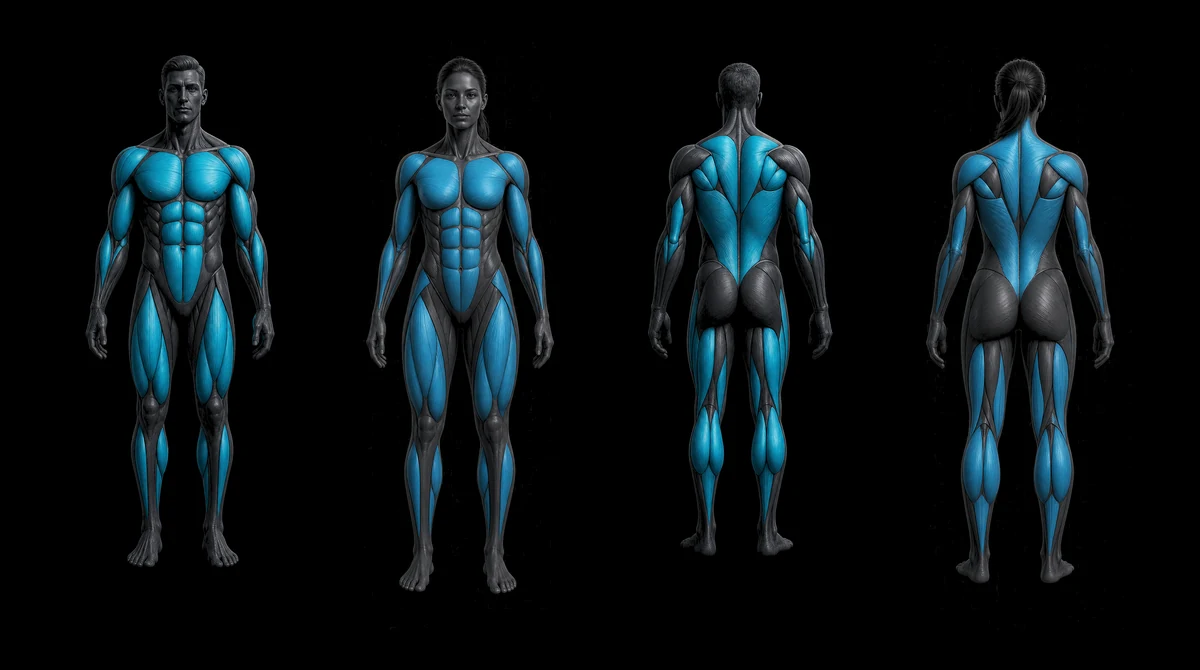
You think you're training balanced. The heatmap of your last 12 weeks says your posterior chain is on holiday.
This isn't an unusual finding. Most intermediate lifters who've been following a push/pull/legs or upper/lower split for a year or more carry the same blind spot: training volume looks distributed in their head, but when you aggregate it by effective sets per muscle group, the bias is obvious. Chest, quads, and anterior deltoids are lit up. Rear delts, hamstrings, and thoracic erectors are cold.
The Muscle Heatmap in Intrvl exists to surface exactly this. It doesn't add complexity. It shows you what your training actually is, not what you remember it being.
Coming in Intrvl v3. The Muscle Heatmap is landing in version 3 and is still in active development. The specifics described here, from the metrics to the layout, may change before release.
Why intermediate lifters drift toward imbalance
The drift is predictable and almost never deliberate. A few mechanisms drive it.
Exercise preference. The bench press, squat, and overhead press feel good. They're socially rewarded in gym culture. Exercises you're strong at get programmed more often than exercises that expose weakness.
Equipment availability. Gyms with three flat benches and one cable stack push athletes toward horizontal pressing by default. The path of least friction shapes the programme.
Mirror muscles. Everything you can see in the mirror gets attention. Everything behind you is abstract. Rear delts and hamstrings don't have the same feedback loop.
Ego lifts. Heavy work on your strongest patterns is reinforcing. Volume creeps up on the lifts that feel good and stagnates on the ones that don't.
Over time, these small biases compound. The anterior chain handles more weekly effective volume than the posterior, hip flexors tighten as hamstrings underwork, and the shoulder capsule starts managing an imbalanced load. You don't notice until something hurts.
What the Muscle Heatmap actually measures
The heatmap aggregates effective volume per muscle group across a rolling window, displayed across front and back body maps.
The critical word here is "effective." Intrvl's Muscle Heatmap doesn't count every set you logged. It counts effective sets: working sets only, with warm-ups excluded entirely. If you did four sets of bench and two of them were lighter warm-up sets tagged as warm-ups, the heatmap credits chest with two effective sets, not four.
This matters because total set count is a poor proxy for training stimulus. Schoenfeld's work on volume dose-response for hypertrophy operates on the assumption of proximity to failure and meaningful mechanical tension. A 50% 1RM warm-up doesn't contribute to that. Effective volume does. The heatmap is built on that distinction.
The colour distribution tells you relative volume across muscle groups. Muscles receiving higher effective weekly volume show as brighter cyan. Muscles receiving little or none stay dark. You can immediately see where the stimulus is going and where it isn't.
All of this is calculated on-device. No data leaves your phone. Analytics aren't behind a separate tier; the heatmap ships with both Premium and Lifetime.
Reading the map: hot zones, cold zones, and what asymmetries mean
Pull up the front view and you'll see how the anterior chain accumulates volume.
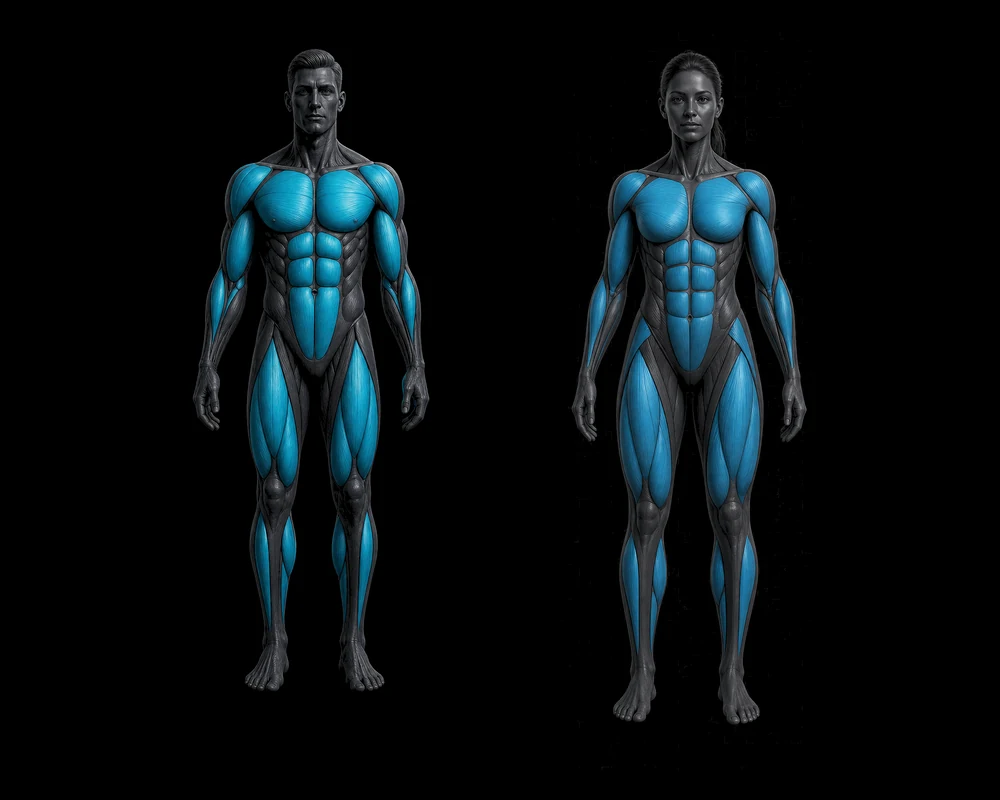
A typical chest-dominant push/pull/legs athlete shows bright quads, bright chest, and moderately lit anterior deltoids. The front view often looks well-populated. This is the trap. The front view alone can make your training look balanced when it isn't.
Now look at the back view.
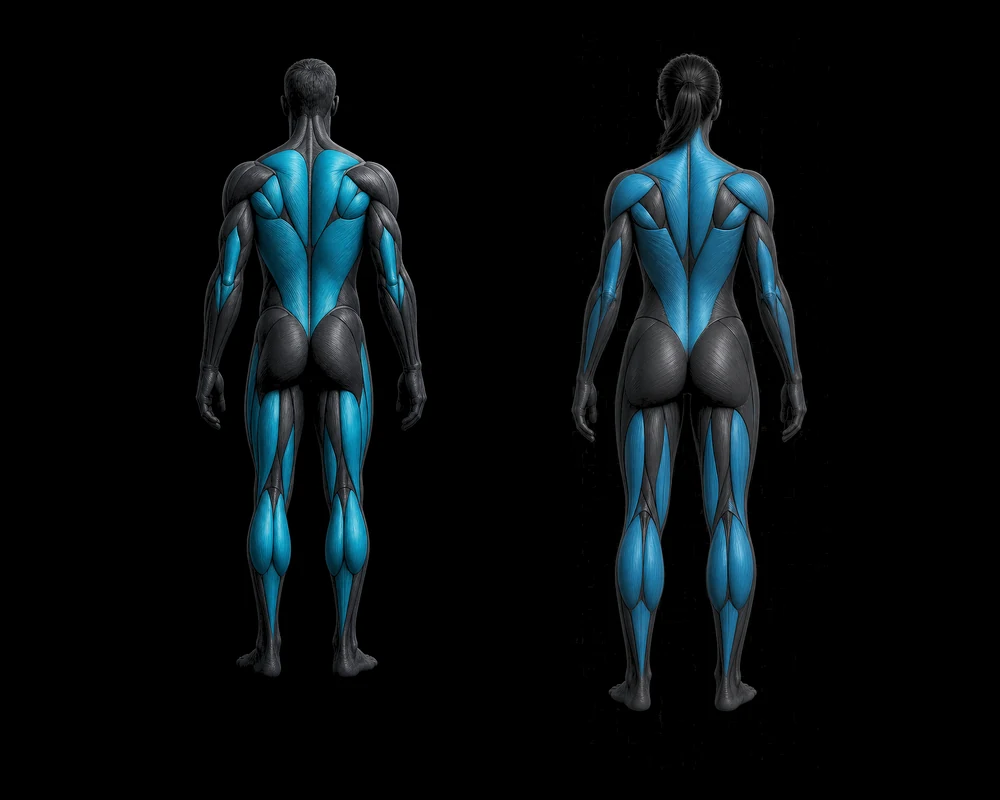
Cold hamstrings. Dark posterior deltoids. Minimal colour across the thoracic erectors. This is the more useful view for most intermediate lifters, because it's where programming holes hide.
The asymmetries to watch:
- Anterior deltoid bright, posterior deltoid cold. Classic internal rotation loading pattern. Over time, this contributes to shoulder impingement territory.
- Quads lit, hamstrings dark. Common on programmes that count leg press and hack squat as "leg work." Hip-dominant posterior chain work doesn't automatically follow.
- Chest and lat volume even, but rear delt cold. Horizontal pulling is happening, but the rotator cuff supporting musculature is understimulated.
- Biceps lit, triceps cold (or vice versa). Usually an artefact of isolation work habits or which arm day exercises get dropped when short on time.
A single-week map is informative. A rolling four-week window is actionable. Patterns that appear consistently indicate structural programming bias, not one-off variation.
Case study: rebalancing a chest-dominant PPL split
The starting point: a three-day push/pull/legs split, run consistently for six months. The athlete was progressing on bench and quad work. No injuries. The heatmap showed posterior deltoids and hamstrings receiving roughly a third of the effective volume of chest and quads over the preceding four weeks.
Week 1: Audit. No changes to the programme yet. The goal was to identify which exercises were contributing to the cold zones and whether any were logged but not completing, or simply absent.
Finding: hamstrings were represented only by Romanian deadlifts, one set of which was typically warm-up tagged. Rear delts had a single face-pull in the pull day that was frequently skipped when short on time.
Week 2: Structural fix. Romanian deadlifts moved earlier in the leg session. A second exercise (lying leg curl, three working sets) added. Rear delt work moved to the start of pull day, not the end.
Week 3: The back heatmap view started showing colour in hamstrings. Rear deltoids still cold, but trending warmer.
Week 4: Effective volume for hamstrings had doubled. Rear deltoid volume was now within a comparable range of lateral deltoid volume. The athlete reported that their upper back felt more engaged during pressing, which tracks: posterior shoulder stability changes how the anterior chain loads.
This is the correct use of the heatmap: not as a real-time programme generator, but as a feedback loop over weeks. You run your programme, the heatmap shows you where the volume is actually landing, and you make structural adjustments.
When a cold muscle isn't a problem
A dark zone on the heatmap doesn't automatically mean your programme is broken. Context matters.
A specialisation block intentionally overloads one muscle group while maintenance volume handles everything else. If you're running an arm specialisation cycle, your hips being cold is expected.
A planned deload or low-volume week will show reduced brightness everywhere. That's the point.
A return-from-injury protocol may deliberately exclude a muscle group for a defined period. The heatmap will show the absence, but that absence is prescribed.
The flag is when a muscle group is cold without explanation. You didn't plan to under-train your hamstrings. You didn't intend to skip rear delt work. You were just following the programme as you remembered it, and the training stimulus drifted away from what the programme intended.
That's the gap the heatmap closes. The muscle-group volume tracker shows you the difference between the programme you think you're running and the one your body is actually experiencing.
The bottom line
Imbalances at the intermediate level rarely arrive suddenly. They develop across months of small preference-driven biases. By the time something hurts, the volume distribution has been skewed for long enough that correcting it takes weeks of deliberate work.
Reading the Muscle Heatmap regularly, particularly the back view, short-circuits that process. You catch the posterior chain going cold at week four, not week twenty. You catch the missing rear delt volume before the shoulder starts complaining.
The map won't write your programme for you. But it will tell you if what you're running matches what you intended. For intermediate athletes at the stage where training history accumulates fast enough to produce bias, that feedback is worth more than another rep scheme.
Time every interval. Track every lift. Know what works.
Try Intrvl free for 7 days. Subscribe for $39.99/year or unlock forever for $79.99.