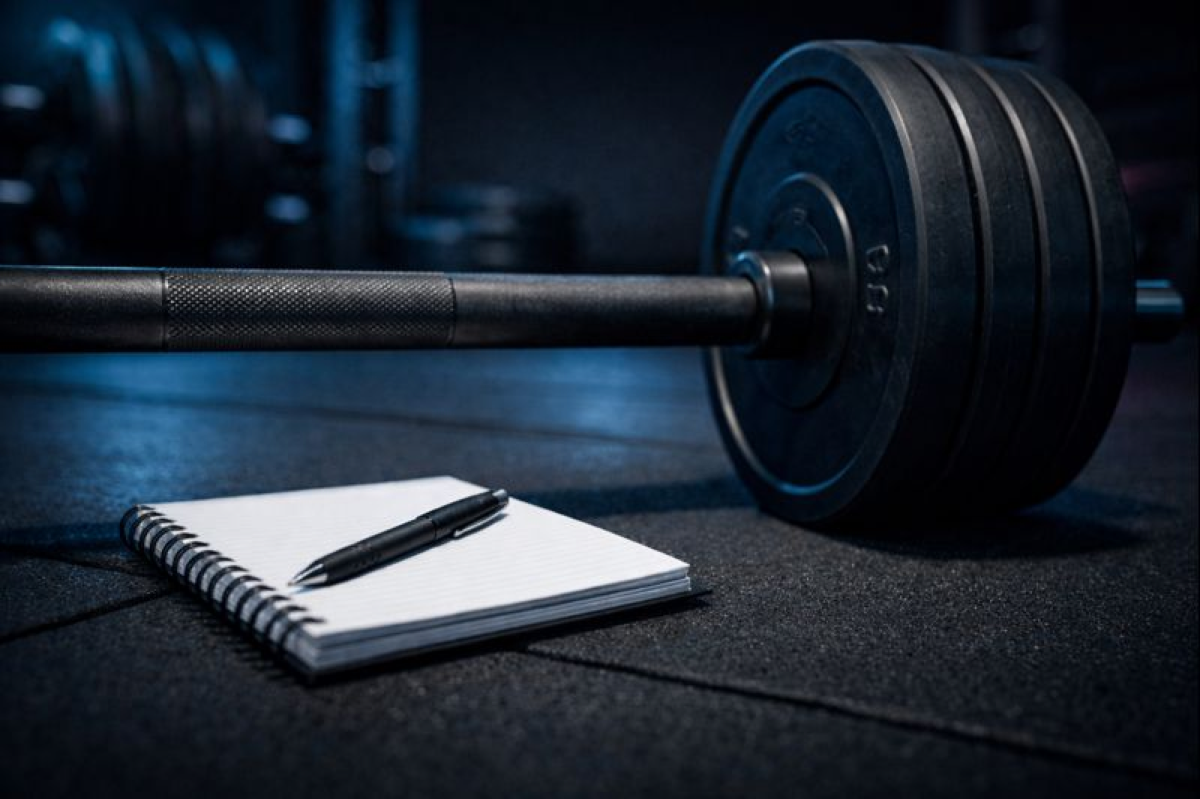
Walk into any serious powerlifting gym and you'll see it: lifters with weathered notebooks, scribbling numbers between sets. In 2026, with training apps everywhere, the pen-and-paper crowd isn't going anywhere.
They're not luddites. They're onto something.
What paper gets right
Single-purpose focus.
Open your notebook. Write your numbers. Close it. No notifications. No Instagram. No algorithm trying to sell you supplements between sets.
Paper enforces exactly one task: record what you lifted. That constraint is a feature, not a limitation.
Zero learning curve.
Exercise name, weight, reps. Three columns. Anyone can start logging in under ten seconds. No tutorial screens, no subscription prompts, no "would you like to enable notifications?"
No battery anxiety.
Your notebook won't die halfway through your session. It won't crash during a PR attempt. It won't force an update when you're ready to train.
Tactile commitment.
Writing numbers by hand creates a different relationship with your data. The physical act of recording makes each set feel more deliberate. You're not just tapping a screen — you're documenting work.
These aren't small advantages. For many lifters, paper solves the distraction problem that training apps create.
The cost of analog tracking
But paper enforces trade-offs that compound over time.
Progressive overload requires pattern recognition.
You need to see whether you're lifting more weight, completing more reps, or handling more volume than last week. With paper, that means flipping backward through pages, squinting at previous sessions, mentally calculating whether 3x8 at 100kg beats last week's 3x7 at 102.5kg.
You can do it. But you're doing mathematics between sets when you should be resting.
Volume trends are invisible.
How much total volume did you accumulate last month? Which muscle groups are you undertraining? Paper doesn't aggregate data — it just stores it. You can manually tally everything into a spreadsheet later, but most lifters don't. The data sits in a notebook, unused.
Rest periods are guesswork.
You know the research: 30-90 seconds for endurance, 1-3 minutes for hypertrophy, 3-5+ minutes for strength. But paper can't time your rest. You're either watching the gym clock (if there is one), using your phone's timer (reintroducing distraction), or estimating.
Estimation means you're probably rushing rest. And rushed rest leaves gains on the table.
Warm-up sets pollute your volume calculations.
If you're manually tracking volume, you're either counting warm-ups (inflating your numbers) or trying to remember which sets were work sets (error-prone). Paper doesn't distinguish between a 20kg bar warm-up and a top set at 150kg — it's all just numbers on a page.
Failure sets look identical to regular sets.
Taking a set to failure costs more recovery than stopping two reps short. But on paper, both entries look the same: "3x8 at 100kg." You lose context that matters for programming decisions.
Digital minimalism: the analog experience with modern analytics
What if you could keep the focus of paper — single-purpose interaction, minimal friction, no algorithmic noise — and add the analytical precision paper can't deliver?
That's the design constraint behind Intrvl.
Unified timer and logging.
You're not switching between a timer app and a tracking app. Rest countdown and weight entry happen in the same interface. Like paper, it's a single-purpose tool. Unlike paper, it times your rest periods accurately.
Warm-up tagging.
Mark a set as a warm-up. It's excluded from your Effective Volume calculations. Your metrics reflect work that counts, not preparatory sets.
Failure set marking.
Tag sets taken to failure. Your Strain Score adjusts automatically, accounting for the additional recovery cost. The data preserves context that paper discards.
Progressive overload tracking.
See exactly what you lifted last session. No flipping through pages. No mental arithmetic. Load the same workout and your previous numbers are right there.
On-device analytics.
Volume trends, muscle group distribution, training density calculations — all processed locally. No cloud dependency, no premium tier for analytics. The app calculates what paper can't.
Want to know your total quad volume over the past four weeks? It's there. Want to see if you're undertraining posterior chain? Muscle Heatmap shows you. Want to track whether your rest periods are creeping shorter? Training Density quantifies it.
Paper can't do this. Most training apps lock these insights behind premium tiers. Intrvl includes them in the base price.
The distraction problem
The pen-and-paper crowd isn't wrong about distraction. Training apps often create more friction than they solve: excessive features, social feeds, gamification, notifications.
Intrvl rejects that model. No workout videos. No AI coach. No social features. No subscription pressure. Just data that respects your intelligence.
You interact with the app during rest periods — the same moments you'd be writing in a notebook. The rest of your session is yours.
When paper still wins
If you're training purely for movement practice — no progression schemes, no volume targets, just showing up and lifting — paper is fine. If you don't care about tracking trends or optimising rest periods, a notebook and pen will serve you well.
But if you're chasing strength gains, hypertrophy, or competition results, paper caps your potential. You're making programming decisions without the data to validate them.
The reality: most lifters don't analyse their notebooks
Here's what actually happens with pen and paper: you record your numbers, you feel disciplined, and then the data sits unused. Maybe you glance back one session. Maybe you transcribe it into a spreadsheet someday. Maybe you don't.
The paper method works if you analyse the data. But manual analysis is friction, and friction means most people don't do it.
Automated analytics remove that friction. Your data is always aggregated, always current, always accessible. You don't need to do the mathematics — you just need to look.
Precision tools for serious lifters
The best training log is the one that:
- Doesn't distract you during your session
- Accurately times your rest periods
- Tracks progressive overload without manual calculations
- Distinguishes warm-ups from work sets
- Aggregates trends you'd never spot manually
Paper delivers on point one. Intrvl delivers on all five.
If you're still using a notebook because training apps feel bloated or distracting, try a different model: Less Screen Time, Better Workouts explains how minimal-interaction tracking preserves focus while capturing the data paper misses.
And if you're curious how much detail you actually need to track, The Single-Purpose Tool Philosophy breaks down what matters versus what's just noise.
Rest properly. Track consistently. Progress deliberately.
Try Intrvl free for 7 days. $39.99/year or $79.99 lifetime. No ads. All analytics included.
Try Intrvl: https://intrvl.app